Hands-on, at their pace
Montessori-Inspired Toys for Home: What to Choose
Start with an action the child already wants to repeat: tip, stack, open, thread, or match. Our Montessori-inspired shelf brings together home activities around those actions. A wooden finish alone is not our reason to include a toy, and these picks are not a certified Montessori classroom curriculum.
Researched buying advice; no hands-on testing is claimed. Retailer ratings are dated snapshots. See how we pick · Affiliate disclosure
Start with the decision
Choose by the situation below, then check the product’s age and household fit.
Nesting and stacking, from 10 months
mushie Stacking Cups →Eight cups offer size comparisons without a large storage footprint. Start with a few cups on a dry surface; any water play needs close supervision and drying afterward.
Matching two parts, from 18 months
Learning Resources Snap-n-Learn Matching Dinos →Pulling apart and joining dinosaur halves gives a clear matching task. Offer a few pairs first so finding a partner is manageable, then add more as the child wants them.
Opening everyday mechanisms, ages 3+
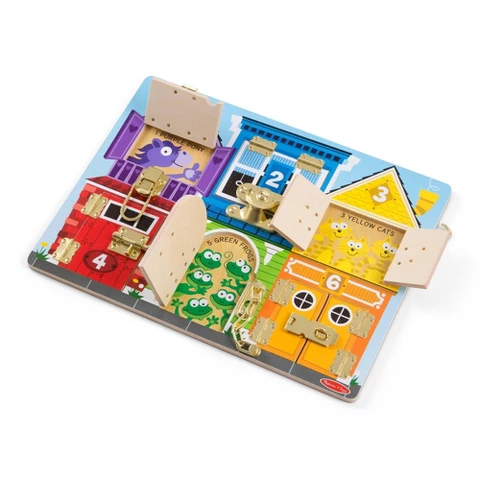
Melissa & Doug Latches Board →Six latches provide different opening actions on one board. Choose it when doors and fastenings are the attraction and keeping the activity together matters more than loose-piece construction.
Threading and simple patterns, ages 3+
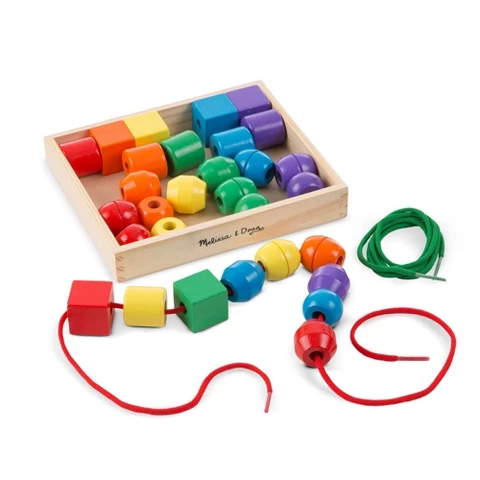
Melissa & Doug Primary Lacing Beads →Thirty beads and two laces can support sorting before threading. Keep the loose beads on a tray and introduce a short sequence rather than expecting a finished necklace immediately.
Matching pictures or making mosaics, ages 3+
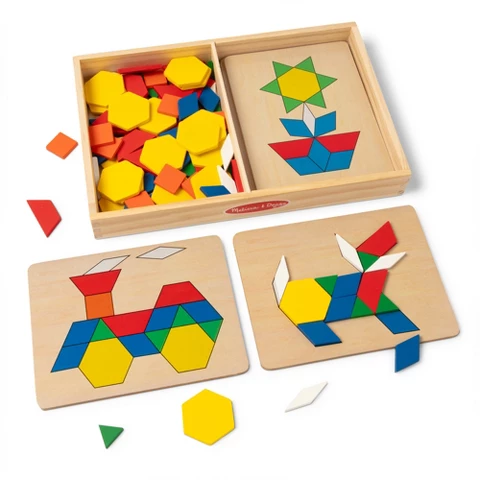
Melissa & Doug Pattern Blocks and Boards →Reusable boards provide a picture to match, while loose shapes also allow original arrangements. Choose it for a child who wants a visual puzzle or an open-ended design task.
Compare 5 picks at a glance
Estimated budget bands, not live prices. Scroll the table sideways on small screens.
| Gift / age | Budget band | A reason to choose it | Check first |
|---|---|---|---|
| mushie Stacking CupsAges 1–3 | Under $25 | Compact storage and open-ended nesting matter most. | The recipient already has a similar set and needs a different activity. |
| Learning Resources Snap-n-Learn Matching DinosAges 2–4 | Under $25 | Children who like repeating a physical action at their own pace. | The manufacturer minimum is 18 months; our full-year filter starts at two. |
| Melissa & Doug Latches BoardAges 3–6 | $25–$50 | Preschoolers interested in mechanisms | For ages 3+; supervise fingers around the hardware |
| Melissa & Doug Primary Lacing BeadsAges 3–6 | Under $25 | Preschool fine-motor practice | Ages 3+; keep beads and cords away from younger siblings |
| Melissa & Doug Pattern Blocks and BoardsAges 3–8 | Under $25 | Children who enjoy shapes and repeating patterns | Many loose pieces need a container and a clear play area |
Choose the action before the material
Cups offer nesting and stacking, dinosaur halves offer matching, and latches offer opening and closing. Lacing beads add a threading task; pattern blocks add shapes to arrange. Watch which action the child chooses during ordinary play. Our suggestion is to offer a manageable version of that action before adding a new demand.
Use month-based labels for younger children
Mushie's current recommendation for the cups is 10 months and up. Learning Resources lists the matching dinosaurs from 18 months. Those are different starting points from the three-and-up beads and pattern blocks. The site filters whole-year gift ages, so read the exact product label as well as choosing an age filter.
Sources: mushie (opens in a new tab), Learning Resources (opens in a new tab), Melissa & Doug (opens in a new tab), Melissa & Doug (opens in a new tab)
Compare loose pieces with an attached activity
The latches board keeps its opening mechanisms on one board. Beads, dinosaur halves and pattern blocks need somewhere to contain and count the parts. For a shared room, choose a setup where the activity can be supervised and packed away before younger children enter. Check fingers around hardware and keep cords and small pieces appropriate to the child's age.
Sources: Target / Melissa & Doug (opens in a new tab), Melissa & Doug (opens in a new tab)
Leave room for the child to change the task
Templates can give a starting point without deciding every move. Melissa & Doug’s Pattern Blocks and Boards has 120 shapes and five double-sided boards; a child can match a picture or arrange an original mosaic. Our older-child fit comes from that open-ended use, rather than a promise that every eight-year-old will want a preschool activity.
Sources: Melissa & Doug (opens in a new tab)
Make the gift easy to put away
A tray and a small selection of pieces can be more approachable than putting everything out at once. Before gifting, consider where wet cups will dry or loose shapes will live. Check each product’s age label and buying brief, especially if the activity shares a room with younger children.
The short list
Use Save to keep a candidate and Compare to put up to three side by side. Open the full brief for contents, play ideas, sources, and trade-offs.

Gift ages 1–3
mushie Stacking Cups
Eight nesting cups for stacking towers, fitting sizes together, and water play.

Gift ages 2–4
Learning Resources Snap-n-Learn Matching Dinos
Nine two-piece dinosaurs, 18 pieces total.
Gift ages 3–6
Melissa & Doug Latches Board
Six different latches give curious preschoolers a place to practice opening and closing.
Gift ages 3–6
Melissa & Doug Primary Lacing Beads
Chunky wooden beads for threading, sorting, and making simple repeating patterns.
Gift ages 3–8
Melissa & Doug Pattern Blocks and Boards
Wooden shapes and reusable templates for sorting, matching, and making original mosaics.
Ready to check retailer prices?
- mushie Stacking CupsCheck price at Amazon for mushie Stacking Cups (opens in a new tab) ↗
- Learning Resources Snap-n-Learn Matching DinosCheck price at Amazon for Learning Resources Snap-n-Learn Matching Dinos (opens in a new tab) ↗
- Melissa & Doug Latches BoardCheck price at Amazon for Melissa & Doug Latches Board (opens in a new tab) ↗
- Melissa & Doug Primary Lacing BeadsCheck price at Amazon for Melissa & Doug Primary Lacing Beads (opens in a new tab) ↗
- Melissa & Doug Pattern Blocks and BoardsCheck price at Amazon for Melissa & Doug Pattern Blocks and Boards (opens in a new tab) ↗
Amazon links can earn a commission. Other retailer links are direct; prices and stock are confirmed by the retailer.
Before you choose
Are all wooden toys Montessori toys?
We do not use wood as a certification. Our collection is labeled Montessori-inspired because of the hands-on activities it offers. Choose for the child’s interests and the task, and use the maker’s age guidance.
Which pick offers a next step beyond stacking?
For a child already interested in matching pictures, the pattern-block set offers templates and free-form designs. For a child fascinated by everyday mechanisms, consider the latches board. Compare their age labels and loose-piece needs before deciding.
How much should an adult set up?
Our practical starting point is a clear surface and a small selection of appropriate pieces. Demonstrate one action, then give the child time to try. Stay involved where the label, loose parts, cords or water require it; independent choice does not mean unsupervised play.
Do I need to buy a whole matching toy collection?
No. Choose an activity the child does not already have a satisfying way to do. Check what is at home before buying a second stacker or another set of sorting pieces. A tray and a place to keep an existing activity accessible may be more useful than another box.
Checked sources